

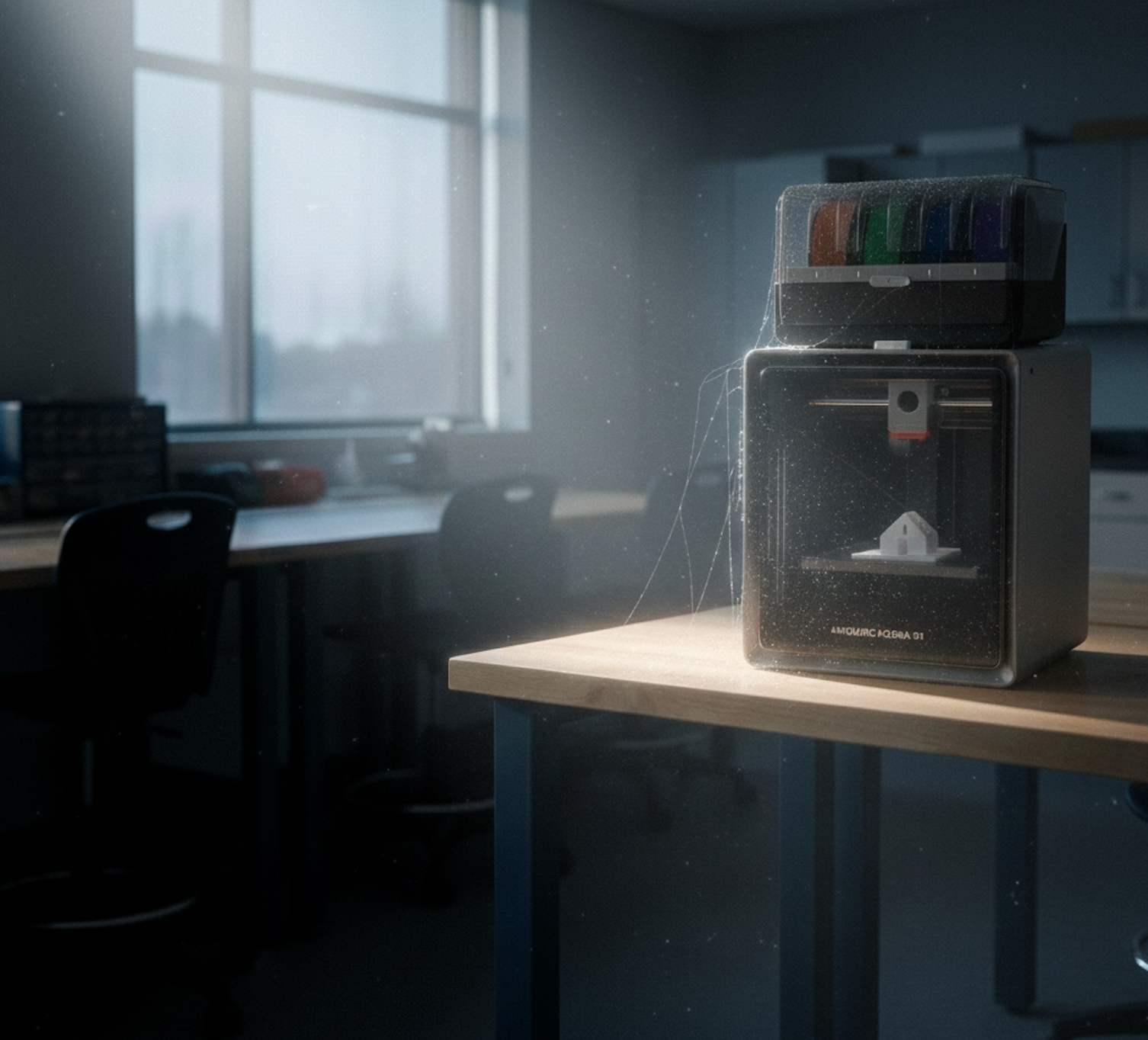
Schools invest in 3D printers with excitement and good intentions. The printer arrives, gets unboxed, maybe there’s a quick demonstration, and then… it sits.
Not because teachers don’t want to use it. Not because students aren’t interested. But because buying the equipment is actually the easy part.
This is a real decision requiring real effort. Having a 3D printer is very important in today’s classrooms – but having one sitting unused and gathering dust is worse than not having one at all. It represents wasted investment, missed learning opportunities, and teacher frustration.
The main work starts after the printer arrives.
Training Is Not Optional
I’ve worked with teachers implementing 3D printing. The pattern is clear: schools that provide proper teacher training see the printer used regularly. Schools that skip this step see expensive equipment gathering dust.
“But we’ll figure it out as we go” doesn’t work. Teachers are already overwhelmed. Adding a new technology without training just adds to their stress, not their capabilities.
What teachers actually need to learn:
Basic technical operation: How to load filament, use slicing software, start a print, remove finished objects, basic troubleshooting. This isn’t intuitive, even for tech-comfortable teachers.
Design software basics: At minimum, how to navigate Tinkercad. How to find and download existing models. How to make simple modifications. Many teachers have never used 3D design software.
Lesson integration: This is crucial – not “here’s how the printer works” but “here’s how you integrate this into a geometry lesson you already teach.” Teachers need concrete examples in their subject area.
Safety protocols: What students can and cannot do. Age-appropriate supervision levels. How to establish classroom routines around the printer.
Troubleshooting common problems: Failed prints happen. Teachers need to understand why and how to fix basic issues without panicking or giving up.
A single training session covers these basics. But here’s the reality: even after training, not every teacher is ready to start using it immediately.
The Gap Between Training and Implementation
This is what schools don’t expect: teachers leave training understanding the concepts but not feeling confident enough to actually use the printer with students.
They worry: What if it breaks? What if students ask questions I can’t answer? What if the print fails in front of the class? What if I waste expensive filament?
These aren’t unreasonable fears. They’re the normal response to adopting unfamiliar technology with real students watching.
This is where most school 3D printing initiatives fail – in the gap between training and confident classroom use.
Why Ongoing Support Matters
Someone needs to be responsible for guiding and monitoring teachers as they start integrating 3D printing into their practice.
Not controlling. Not hovering. But available, encouraging, troubleshooting, and supporting.
What this person does:
Checks in regularly: “Have you tried using the printer yet? What’s stopping you? What support do you need?”
Helps plan first lessons: Works with teachers to design that crucial first 3D printing lesson in their classroom. Provides templates, suggests modifications, offers to be present during the lesson.
Troubleshoots problems: When prints fail or technical issues arise, responds quickly so teachers don’t feel stranded.
Celebrates successes: Shares photos of student work, highlights teacher innovations, creates positive momentum.
Identifies and addresses barriers: If teachers aren’t using the printer, finds out why. Too complicated? Not enough time? Curriculum pressure? Then works to solve those specific problems.
Facilitates peer learning: Connects teachers who are succeeding with those still hesitant. Creates opportunities for teachers to share lessons and tips.
This role might be a technology coordinator, a lead teacher who’s comfortable with 3D printing, or an external consultant (like us) who provides ongoing support.
But someone must fill this role. Otherwise, training becomes a one-time event that doesn’t translate to sustained classroom use.
The First Few Months Are Critical
The first semester after getting a 3D printer determines long-term success.
If teachers succeed early: They gain confidence, see student engagement, start planning more projects. The printer becomes integrated into their teaching practice.
If teachers struggle early: They avoid the printer, feel inadequate, decide “it’s not for my subject.” The printer becomes someone else’s problem.
Ongoing support during these critical months makes the difference.
What support looks like in practice:
This scaffolded support allows teachers to build genuine competence and confidence.
What Happens Without Support
I’ve seen it repeatedly: schools buy printers, provide one training session, then assume teachers will figure it out.
What actually happens:
- One or two tech-comfortable teachers use it constantly. They monopolize the printer because they’re comfortable with technology and willing to experiment.
- Most teachers never touch it. They attended training but don’t feel confident enough to try. The printer intimidates them.
- Most students don’t even know it exists. Only the classes of those one or two teachers who use it have access. The rest of the school remains unaware the printer is there.
- Some students ask to use it but can’t. When they do discover it exists, teachers don’t know how to supervise student use, so they default to “not right now.”
- Even years later, many teachers and administrators don’t know about it. I’ve encountered schools where grade-level managers, after years of having 3D printers, didn’t know the equipment existed. The printer lives in one room, used by one person, invisible to the rest of the school.
- The printer eventually breaks from either overuse by the few teachers who use it, or from sitting idle and developing problems no one knows how to fix.
- School administration feels frustrated. They invested money, provided training, but most teachers aren’t using it. They wonder if it was worth it.
This isn’t teacher failure. It’s system failure – expecting technology adoption without the support structure that makes adoption possible.
The Real Cost of 3D Printing in Schools
When schools ask about implementing 3D printing, they focus on equipment cost. “How much for the printer? How much for filament?”
But the real investment is:
The printer might cost 2,500 GEL. But the support system that makes it actually useful? That requires budget, planning, and commitment.
Schools that understand this succeed. Schools that think buying equipment equals implementation don’t.
What Success Looks Like
When implementation includes proper training and ongoing support: Multiple teachers across subjects use the printer regularly. Not just the tech teacher – the math teacher, science teacher, art teacher.
Teachers start with the provided lessons, then develop their own. They move from following templates to creating original applications in their specific subjects.
Students know the routines and expectations. Classroom procedures around 3D printing are established, and students follow them.
Problems get solved quickly. When technical issues arise, there’s a clear process for getting help.
Innovation happens. Teachers start seeing opportunities they didn’t initially imagine. They collaborate across subjects. Students propose projects.
The printer is scheduled, not idle. Multiple classes want access, requiring a rotation system.
This is what proper support creates. Not overnight, but over the first semester with consistent guidance.
For Schools Considering 3D Printers
Before you buy, ask these questions:
Who will train teachers? Not a one-time vendor demo. Real training on operation, design, and curriculum integration.
Who will support teachers after training? Who do they contact when something goes wrong? Who helps them plan lessons? Who encourages hesitant teachers to try?
How will you measure success? Not “do we own a printer” but “how many teachers are actively using it? How many students are creating designs? What learning is happening?”
What’s the timeline for implementation? Understanding that Month 1 looks different from Month 6, and having support scaled accordingly.
What’s the long-term plan? How do you sustain use after initial excitement fades? How do new teachers get trained? How do you maintain equipment?
If you can’t answer these questions, that’s okay – we’re here with all the answers. The important thing is recognizing that these questions need answering before you invest.
For Schools That Already Have Printers Sitting Idle
It’s not too late.
Restart with proper training. Gather teachers, provide comprehensive training, acknowledge that the first attempt didn’t work and you’re trying a better approach.
Assign someone to champion and support. Give them time and authority to help teachers succeed.
Start small but supported. Pick 2-3 willing teachers, help them succeed, then use their success to encourage others.
Share successes visibly. When students create something cool, make sure everyone knows. Post photos. Celebrate in staff meetings. Create positive momentum.
Address specific barriers. Talk to teachers who aren’t using it. What’s stopping them? Then solve those specific problems.
Many idle printers can be revived with this approach. The equipment isn’t the problem – the support system is.
The Bottom Line
Buying a 3D printer for your school is an investment in potential. But potential only becomes reality with training, support, and guidance.
Teachers need to learn not just how it works, but how to integrate it into their teaching practice. They need someone available when problems arise, encouraging them when confidence wavers, and celebrating when students create something amazing.
The printer is the tool. The training is the foundation. The ongoing support is what makes it all work.
Schools that understand this don’t just have 3D printers. They have teachers using 3D printing to enhance learning, students developing real skills, and technology that serves genuine educational purposes.
That’s worth investing in – but it requires investing in more than just the equipment.
Need help implementing 3D printing in your school? We provide both initial teacher training and ongoing support to ensure your investment actually transforms teaching and learning. Contact us to discuss a comprehensive implementation plan: email@3dvinci.space
Leave a Reply