
Back-to-school season has its own kind of energy: new notebooks, freshly sharpened pencils, bags being packed again and a desk waiting for the first homework, drawing or new idea.
At 3D Vinci, this season also brings a question: which small object could make that new routine feel a little more personal?
This year, the answer became clear. It was not one complicated design or one particular colour. It was a name.
Personalised Georgian name keychains, backpack-shaped name tags, pencil name toppers and penholders—especially the hoodie-shaped version—received a lot of attention this season. The familiar, casual shapes attracted people first. But the real hit was personalisation: choosing the colour and seeing an individual Georgian name become part of the object.
Again and again, the most important request was also the simplest: can you add the name?
Why casual shapes felt right
A hoodie and a backpack are ordinary forms, and that may be part of their appeal. They already belong to the visual world of school, hobbies and everyday routines. They do not need to look formal or overly “educational” to feel appropriate for a study corner.
The hoodie-shaped penholder looks relaxed and familiar. The backpack-shaped tag is a playful miniature of the bag it is attached to. Even the simplest name keychain feels lively when two colours and Georgian lettering come together.
These shapes gave us a friendly starting point. Personalisation was what completed them.
The Georgian name keychain: the simplest idea became personal
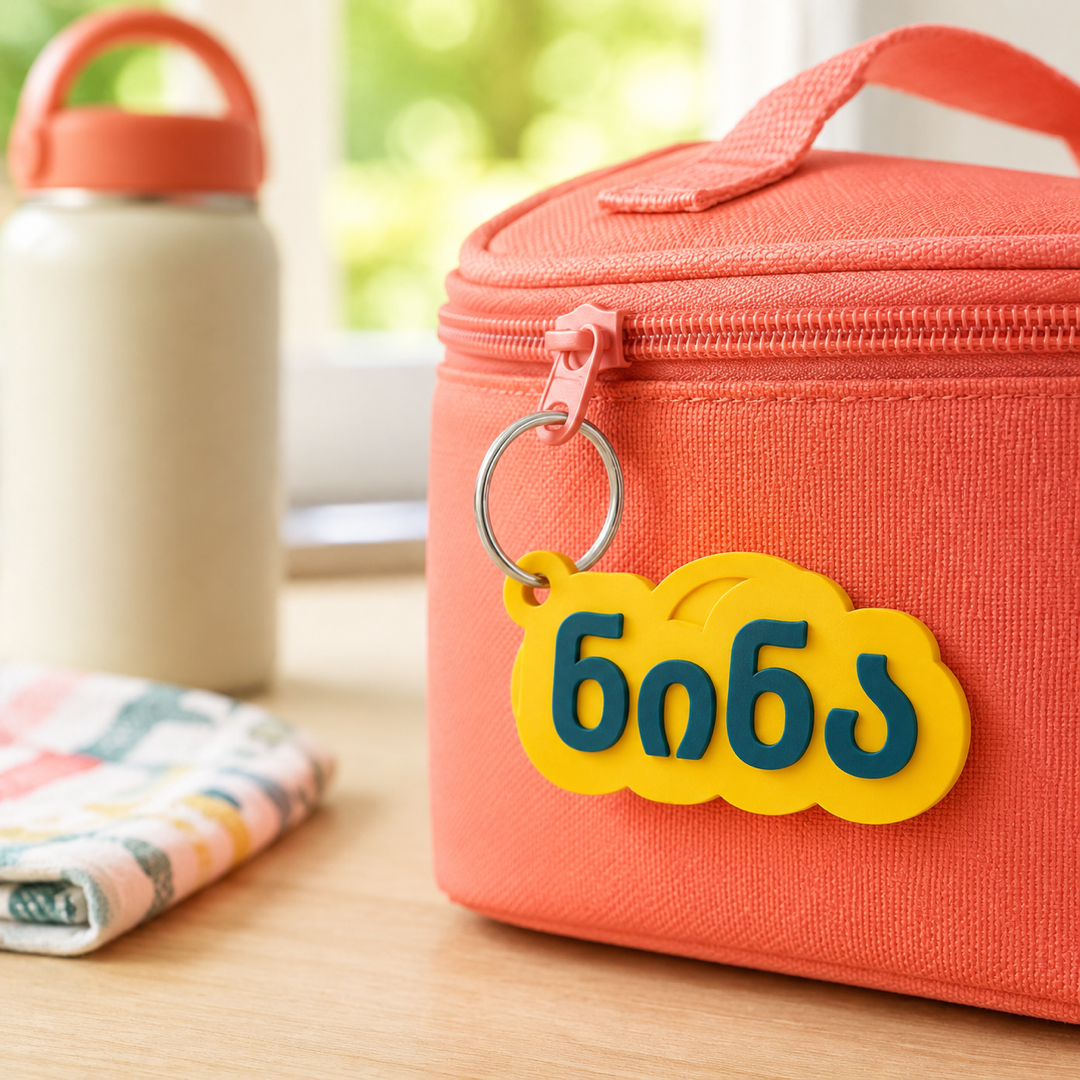
The personalised Georgian name keychain is one of the most straightforward objects in the collection: a name, a background colour and a contrasting top colour. There is no need for a complicated explanation. The name itself becomes the design.
It can move between a backpack, pencil case, lunch bag, sports bag or set of keys. Its practical role is small, but visible: it gives an everyday belonging an individual detail and makes it easier to recognise.
What we especially enjoyed this season was seeing how much the same design could change from one order to another. A bright combination feels playful; darker colours feel more restrained. A short name creates one rhythm, while a longer Georgian name creates another. The basic idea stays simple, but the result no longer feels generic.
The simplest design became one of the most personal: a familiar name in a chosen colour combination.
The backpack-shaped name tag: a small version of the object it belongs to
The Personalised Backpack Name Tag carries the same idea one step further. Instead of placing the name on a neutral shape, the tag becomes a tiny backpack of its own—complete with a front-pocket outline and small raised details.
We like the little visual joke in it: a backpack attached to a backpack. But it is not only decorative. The raised Georgian name and selected colour combination make the tag distinctive and easy to recognise on a school bag, sports bag or pencil case.
It is playful without being complicated, and personal without needing a long message. One small object says exactly who it was made for.
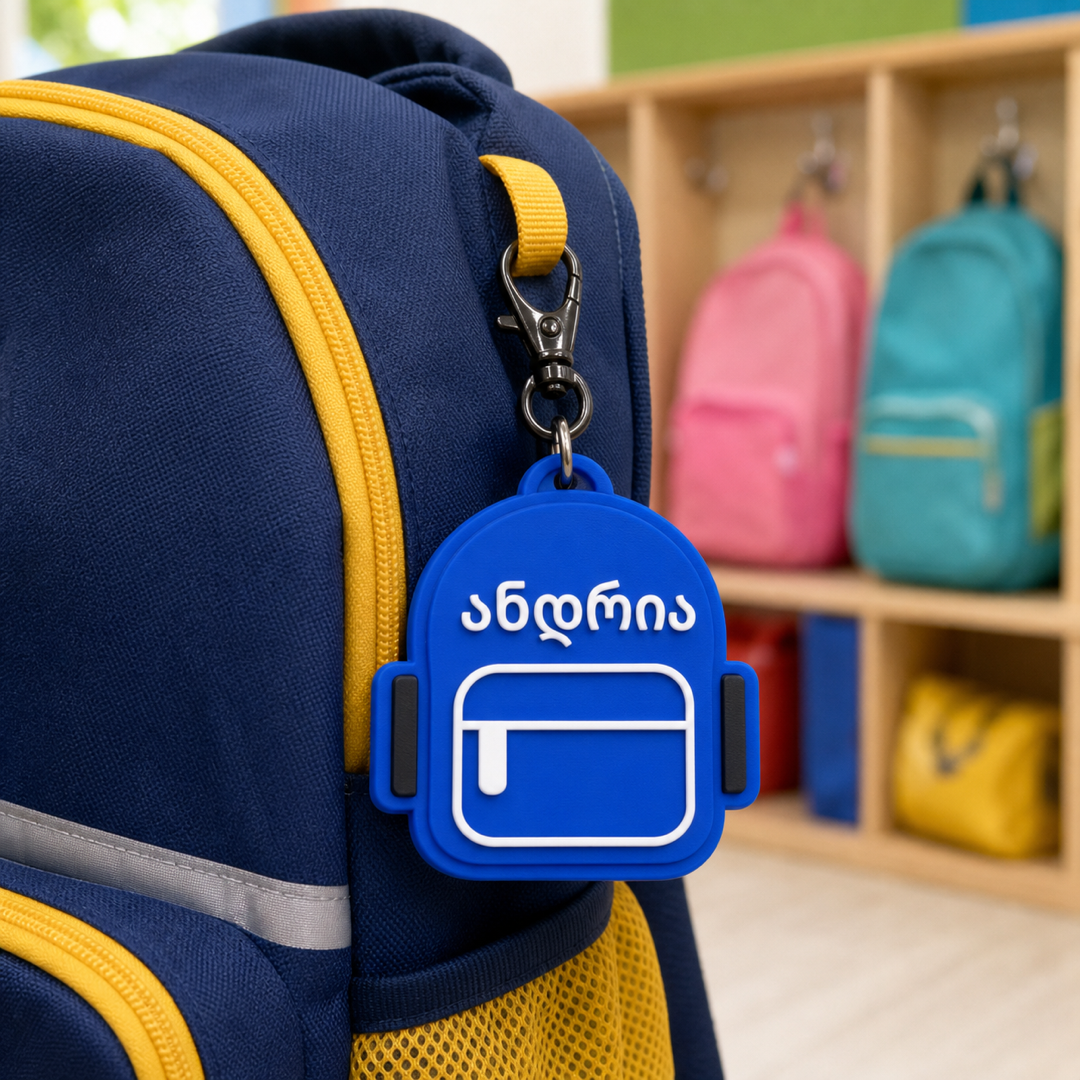
A miniature backpack on a real backpack—the familiar shape gets its own name and colour.
The pencil name topper: personalisation in the smallest detail
Another small favourite carried the same idea directly onto the pencil. The Personalised Georgian Name Pencil Topper fits around the pencil shaft, turning an ordinary writing or drawing tool into something immediately recognisable.
We like how little it changes the object—and how clearly it changes whose object it feels like. A chosen colour and a Georgian name are enough. It may be the clearest example of what this season taught us: personalisation does not need to make an object larger or more complicated. Sometimes it only needs to sit on a pencil.

Sometimes one small name is enough to make an everyday pencil feel unmistakably personal.
The hoodie penholder: the season’s favourite casual shape
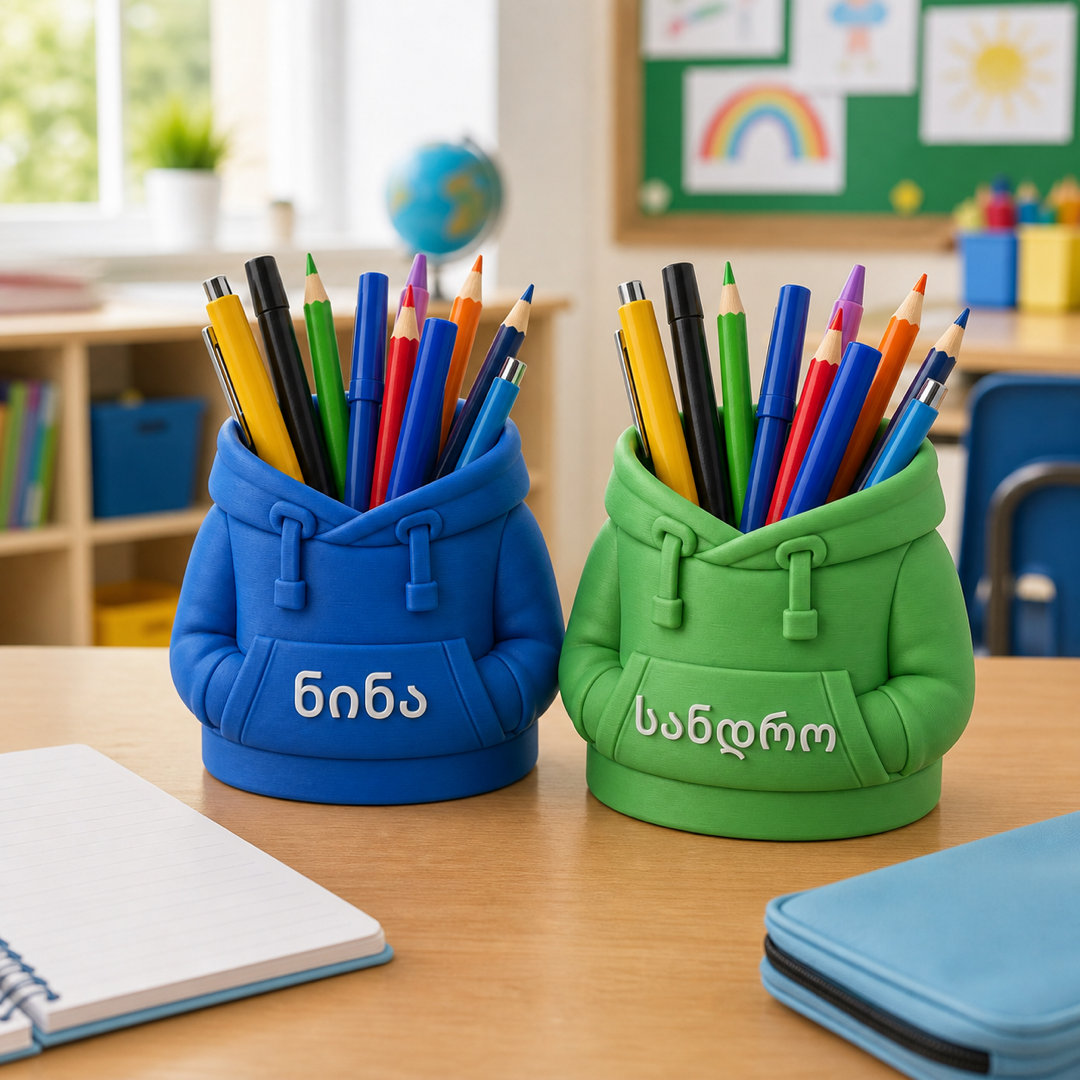
Among the penholders, the hoodie-shaped version drew especially strong interest. Its shape feels contemporary and relaxed, and its function is immediately clear once pencils, pens and markers appear above the hood.
The front pocket gave us the perfect place for a raised Georgian name. That small decision changed the whole relationship with the object. It was no longer simply a colourful holder for a desk; it was a holder prepared for one particular person.
Colour added another layer. A blue hoodie with white lettering feels completely different from a green one with lettering in another tone. Even when the base model is the same, the name and colour combination give each finished piece its own character.
For us, that was one of the warmest parts of the season: imagining each penholder arriving at a new desk and already having its place there.
Personalisation was the real hit
At the beginning of the season, we thought the story would be about shapes. Hoodies, backpacks and other casual forms were clearly popular, and they made ordinary school accessories feel more playful.
But the shape was only half of the story.
The real connection appeared when someone chose a name and a colour. That was the moment a product stopped being simply one of our designs and became their keychain, their backpack tag, their pencil topper or their penholder.
This is one of the things we enjoy most about 3D printing. A digital model does not have to produce one identical result every time. Small decisions—a name, a colour pairing, the way the letters sit on the form—can make a familiar object feel specific to one person.
This season reminded us that popularity does not always come from adding more complexity. Sometimes a simple object succeeds because it gives someone room to recognise themselves in it.
What we are taking into the next season
We are carrying three lessons forward.
First, everyday forms can be strong design ideas. A hoodie or backpack does not need an elaborate story; people already understand the shape and know where it belongs.
Second, personalisation works best when it is part of the design from the beginning. The name should not feel like an afterthought. It needs a clear place, readable lettering and a colour relationship that suits the object.
And third, small school accessories can still feel meaningful. A keychain may be tiny and a penholder may have a very simple job, but both become more memorable when they are made for a particular person.
At the start of the season, the shapes made us smile. By the end, the names were what we remembered.
Leave a Reply