

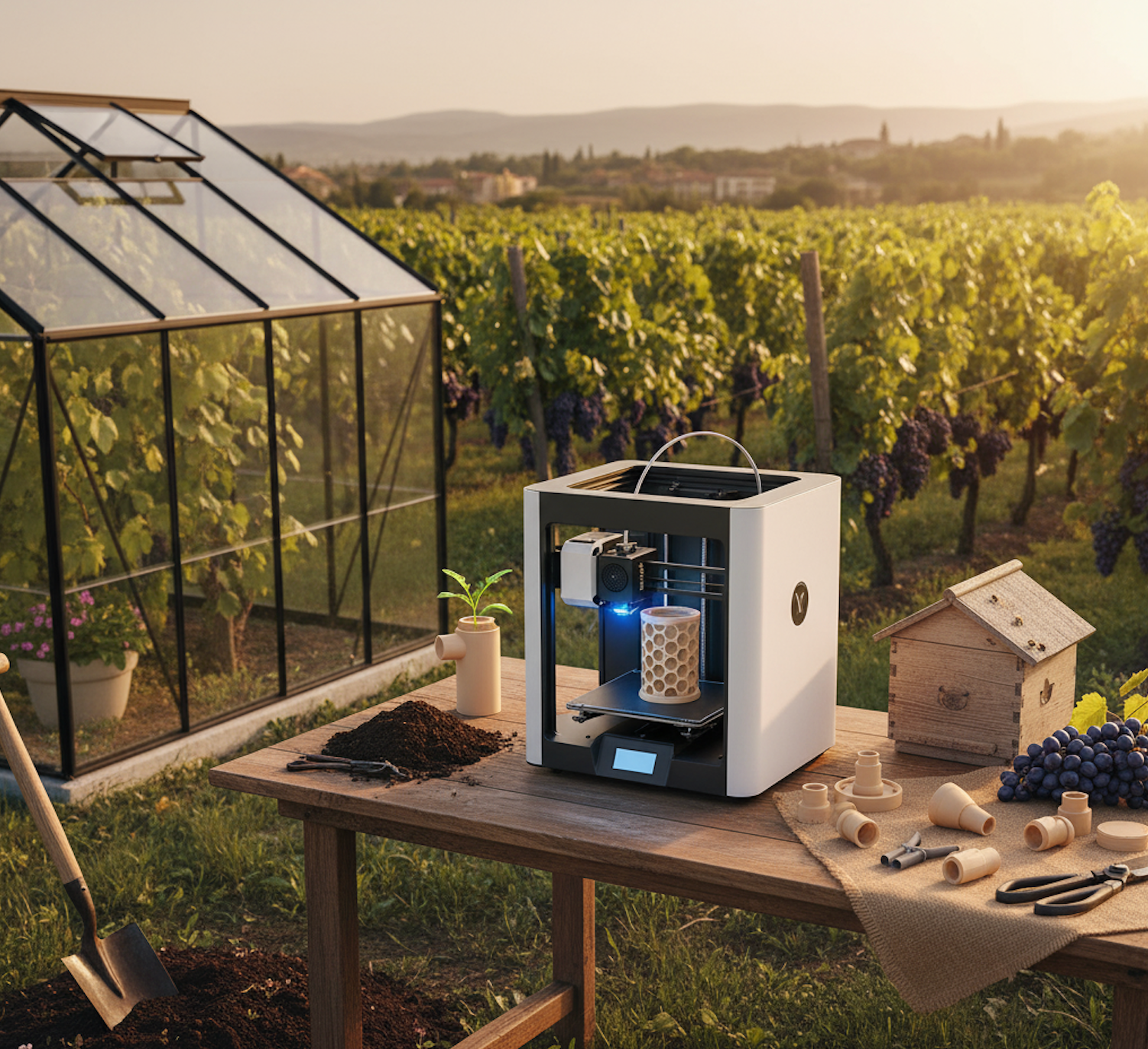
Georgia’s agricultural identity runs deep. For thousands of years, this land has been cultivating grapes, growing wheat, tending orchards, and raising bees. Our wine culture is recognized by UNESCO. Our agricultural heritage is part of our national soul.
But agriculture is also where tradition meets innovation – and that’s where 3D printing enters the story.
When people think about 3D printing applications, agriculture rarely comes to mind first. They imagine medical devices, aerospace components, or educational tools. But the farming sector is experiencing a quiet revolution, and for Georgia specifically, this technology could transform how we approach everything from beekeeping to greenhouse management to maintaining farming equipment.
The Global Agricultural Revolution
The numbers tell a compelling story: agriculture leads growth in the global 3D printing market, with 87% of companies printing more parts than the previous year – exceeding the 70% average across all industries.
This technology offers adjustable equipment and autonomous agricultural instruments like drones and robots, providing real-time data on plant health, nutrient levels, and soil state. AI and 3D-assisted IoT sensors help increase yield by 10-15% while reducing water usage by 20-25%.
For Georgian farmers – particularly smaller operations – this matters because we’re talking about solutions that make farming more efficient, more sustainable, and more profitable at any scale.
Beekeeping: A Georgian Tradition Meets Modern Technology

Beekeeping in Georgia isn’t just agriculture – it’s cultural heritage. Georgian honey has been prized for centuries, and our bee populations are crucial for pollinating our orchards, vineyards, and crops.
A master’s student in Mexico developed 3D printed beehives using advanced resin printing, reconstructing the hexagonal formation bees would otherwise have to build naturally. This releases bees from labor-intensive construction work, letting them focus energy on honey production and reproduction without stress.
Various 3D-printed tools for beekeepers include feeders (both internal and external), queen bee catchers, Asian hornet traps, and customizable hive entrances. For Georgian beekeepers dealing with environmental challenges or trying to expand without massive investment, these are practical, affordable solutions adapted to local conditions and native bee species.
Greenhouse Agriculture: Precision and Customization
Georgia’s greenhouse sector has been growing, particularly around Tbilisi and in regions like Kvemo Kartli and Kakheti. But greenhouse farming comes with challenges: irrigation systems, climate control, specialized equipment, and constant need for replacement parts.
Companies use 3D printers to produce polymer pipes that form a honeycomb structure, allowing water to flow out like a sponge – these pipes absorb moisture from soil and transport it to plants. More than 60% of water in traditional irrigation is wasted due to leakage or evaporation.
For Georgian greenhouse operators, 3D printing means custom irrigation components printed on-site, specialized sprinkler heads designed for specific crops, replacement parts without international shipping delays, and custom mounting systems for exotic plants requiring specific support structures.
3D scanning creates high-resolution digital models of crops, making it easier to monitor growth and detect problems early – valuable for greenhouse operators growing delicate or exotic species.
Farming Equipment: The Spare Parts Challenge
Anyone who’s farmed in Georgia knows this problem: equipment breaks during harvest season, the needed part isn’t available locally, and you wait weeks while crops sit in the field.
Farmers now print spare parts directly on-site, slashing downtime and eliminating long waits. Metal and polymer 3D printing enables production of durable, weather-resistant parts tailored for field conditions and remote operations.
For Georgian agriculture, particularly in regions far from Tbilisi, this is transformative. A farmer in Svaneti or Adjara can produce parts locally rather than waiting for shipments from the capital or abroad. Desktop 3D printers help farmers prototype traditional tools 30% faster than CNC machining.
What This Means for Georgian Agriculture
Georgia’s agricultural sector has unique characteristics that make 3D printing particularly valuable:
Our diverse climate zones mean farming needs vary dramatically from Colchis lowlands to Javakheti highlands – 3D printing enables customization for local conditions.
Our small to medium-sized family farms can access technology without massive capital investment, manufacturing traditional equipment adapted to specific uses.
Our wine industry – crucial to our economy and identity – can use 3D printing for vine training systems, custom tools, and promotional items.
Our push toward organic farming aligns with 3D printing’s sustainability. Agricultural byproducts like fruit peels and grain husks can be converted into printable biopolymers, with biodegradable materials decomposing naturally and eliminating plastic pollution.
Our geographic challenges – farming in mountainous regions where accessing equipment is difficult – make on-site manufacturing particularly valuable.
Practical Applications for Georgian Farmers Today
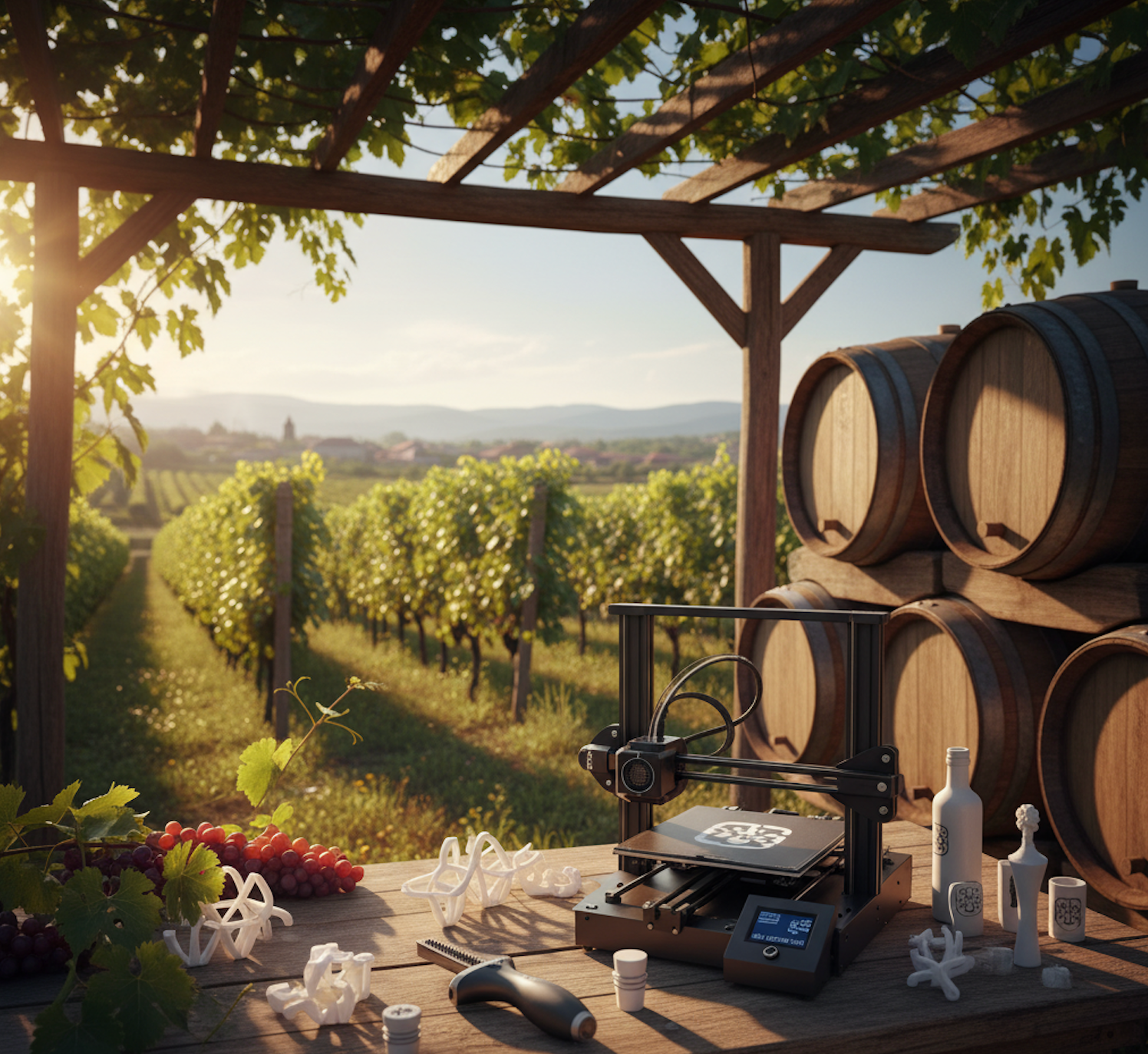
This isn’t future technology. Georgian farmers can start using 3D printing now:
For wine producers: Print custom wine stoppers, vineyard markers with your brand, specialized pruning tool handles adapted to your hand size, training system components for young vines.
For greenhouse operators: Custom drip irrigation nozzles, plant markers with QR codes linking to growing data, specialized seed starting trays, mounting brackets for grow lights.
For beekeepers: Bee feeders, hive entrance reducers for different seasons, queen excluders, frames for specific purposes.
For equipment maintenance: Replacement knobs and handles, simple gears and brackets, protective covers, mounting components.
For specialty crops: Custom harvesting tools for delicate fruits, specialized drying racks for herbs, sorting trays adapted to your specific product.
The Sustainability Advantage
Georgian agriculture increasingly focuses on sustainability – for environmental reasons and for access to European markets that value eco-friendly practices.
3D printing reduces food waste by 10-30% and uses alternative materials sustainably. The 6R model (Reject, Redesign, Reduce, Reuse, Recycle, Recover) cuts farm plastic waste by 44%, while on-site production reduces transport emissions by 30%.
For Georgian farmers selling to European markets or pursuing organic certification, demonstrating sustainable practices becomes a competitive advantage.
Barriers and Realistic Expectations
I want to be honest about challenges:
Initial investment: While 3D printers are more affordable than ever, they still represent an investment. Cooperative purchasing among several farms might make more sense than individual ownership.
Technical knowledge: Someone needs to understand basic 3D design and printing. This could be a younger family member, a tech-savvy neighbor, or a service provider.
Material availability: Printing filament needs to be accessible. As the Georgian market develops, this will become easier.
Design skills: Not every farmer will become a 3D designer. But many designs are available open-source, and local makers or agricultural cooperatives could provide design services.
Realistic applications: 3D printing won’t replace all traditional manufacturing. It’s best for custom parts, replacements, and specialized tools – not for mass production of identical items.
The Path Forward for Georgia
The 3D printing market hit $12 billion in 2020 and is projected to reach $57.1 billion by 2028, with falling costs and improved technologies making 3D printing more accessible to small businesses.
For Georgia, the opportunity is clear: integrate this technology thoughtfully into our agricultural sector, respecting our traditions while embracing innovation that makes farming more efficient, sustainable, and profitable.
Imagine:
- Agricultural cooperatives with shared 3D printing facilities
- Young Georgians returning to family farms armed with technical skills
- Rural maker spaces where farmers access design help and printing services
- Agricultural universities training students in both traditional farming and digital fabrication
- Export products that combine Georgian agricultural heritage with modern technology
This isn’t about abandoning tradition. Georgian agriculture has survived millennia by adapting while preserving what matters. 3D printing is just the latest tool in that long evolution.
From our ancient vineyards to modern greenhouses, from mountain apiaries to mechanized wheat fields, Georgian agriculture continues adapting. And 3D printing offers practical solutions to real challenges we face every day.
Leave a Reply