

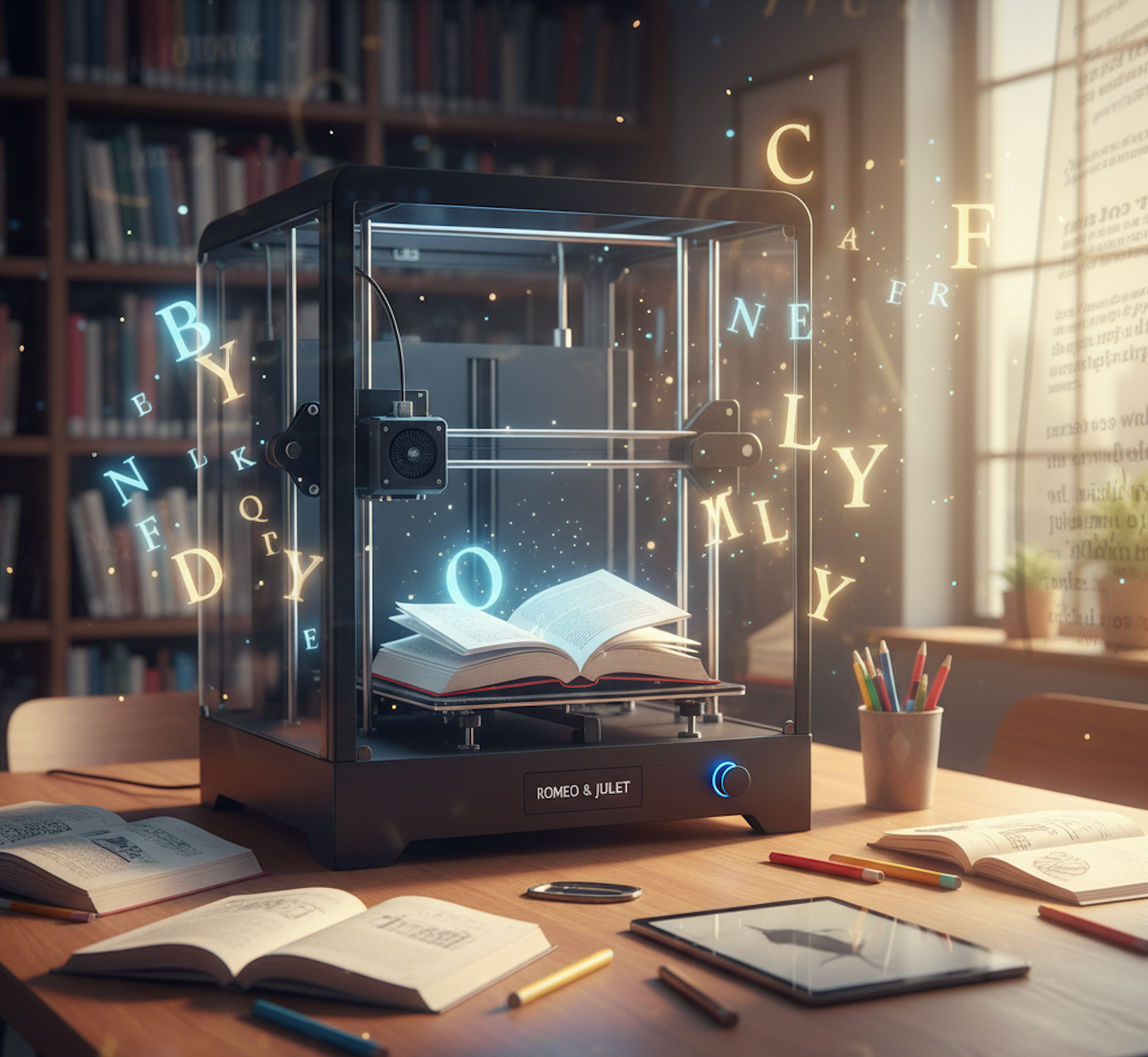
“That’s great for science teachers, but I teach language arts.”
I hear this constantly. Teachers assume 3D printing belongs exclusively in STEM classrooms – that it’s for printing molecular models and geometric shapes, not for exploring literature and developing writers.
I understand why they think this. When you picture a 3D printer in action, you probably imagine a biology teacher printing a cell model or a math teacher creating fraction manipulatives. You don’t imagine students printing the mockingbird from To Kill a Mockingbird or designing the setting of their own creative story.
But here’s what I’ve learned from working with language arts teachers: 3D printing might be more powerful in literature and writing classes than anywhere else.
Let me show you why.
The Question No One Asks
When science teachers want to use 3D printing, no one questions it. Of course you’d print a DNA helix! Obviously you’d create topographical maps!
But when a language arts teacher considers 3D printing, the first response is usually confusion. How does printing a physical object help students understand metaphor? What does a 3D model have to do with character development or theme analysis?
The real question isn’t “how do you use 3D printing in language arts?” The real question is: “How are you currently giving students the chance to demonstrate understanding beyond essays, posters, and multiple-choice tests?”
Because that’s what 3D printing offers language teachers: a completely new way for students to show what they understand about stories, characters, themes, and writing craft.
Making the Abstract Concrete
Literature lives in abstraction. Themes. Symbolism. Character motivation. Internal conflict. These are invisible concepts that we ask students to grasp through words alone.
But what if symbolism could become something students hold in their hands?
Imagine a teacher wrapping up a unit on To Kill a Mockingbird asking students to demonstrate their understanding of a symbol and its connection to theme. Instead of writing another essay, students could use Tinkercad to design 3D representations of symbols from the book. A student might create scales of justice tilted to one side to represent racial injustice. Another could design the mockingbird itself – making visible the central symbol they’ve been analyzing. A third might print the chifferobe that appears during Tom Robinson’s trial – an object mentioned in text becoming tangible, representing the private spaces and hidden truths in the story.
These wouldn’t be decorative projects. They’d be sophisticated literary analysis – made tangible.
The students had to understand the symbol deeply enough to translate it into three dimensions. They had to think about proportion, context, and how to communicate meaning through physical form. That requires a level of comprehension that goes far beyond identifying a symbol on a worksheet.
Character Development: From Flat to Three-Dimensional (Literally)
We tell students to create “three-dimensional characters” in their writing – characters with depth, complexity, contradictions. But that’s a metaphor they’re supposed to understand abstractly.
What if they could literally create their characters in three dimensions?
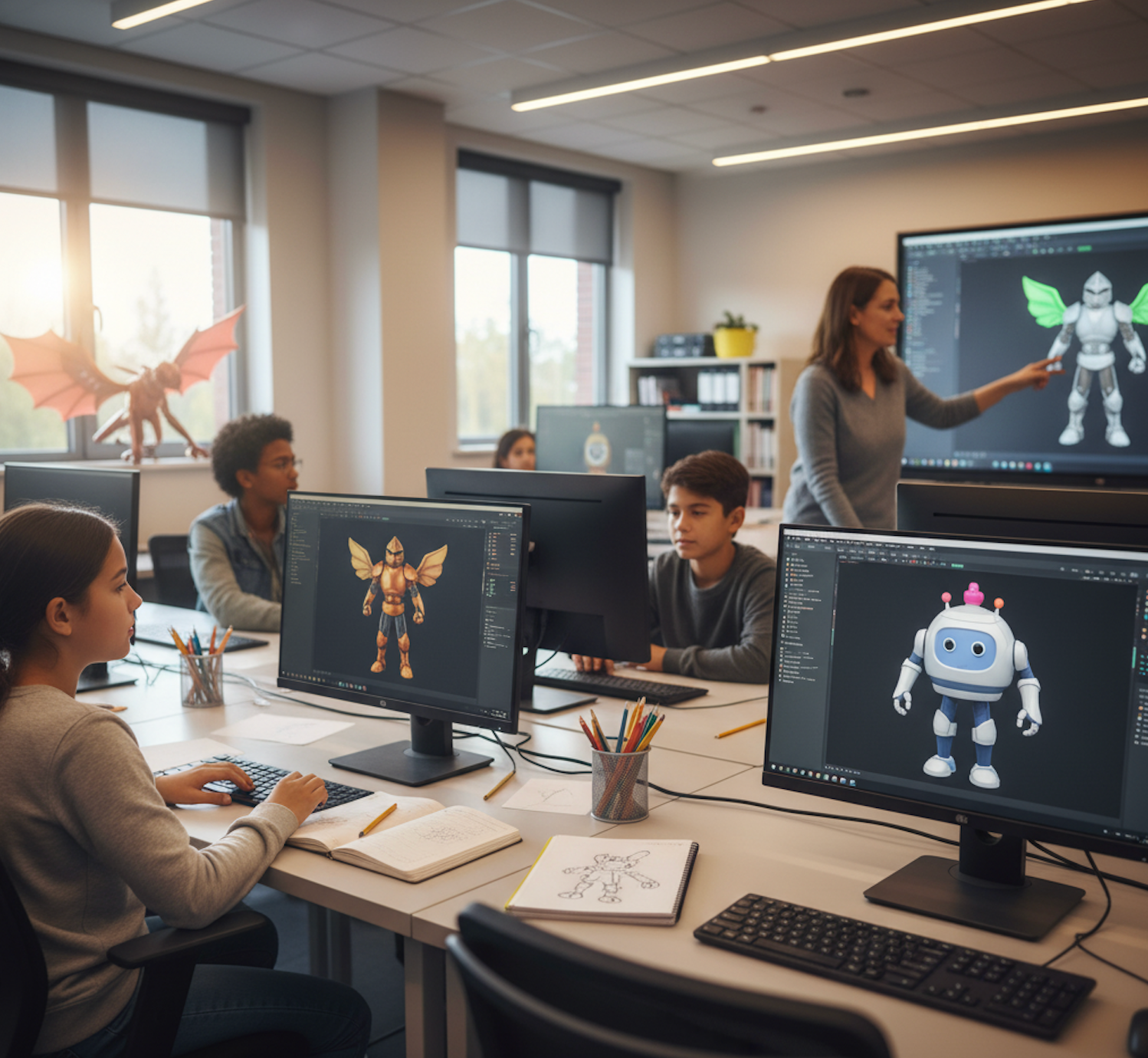
Before students begin writing a narrative, they can design their character in 3D software. The design process helps them get to know their character and collect information to bring their story to life. They have to make decisions: What does this character look like? How do they carry themselves? What objects are important to them?
Setting: Building the World of the Story
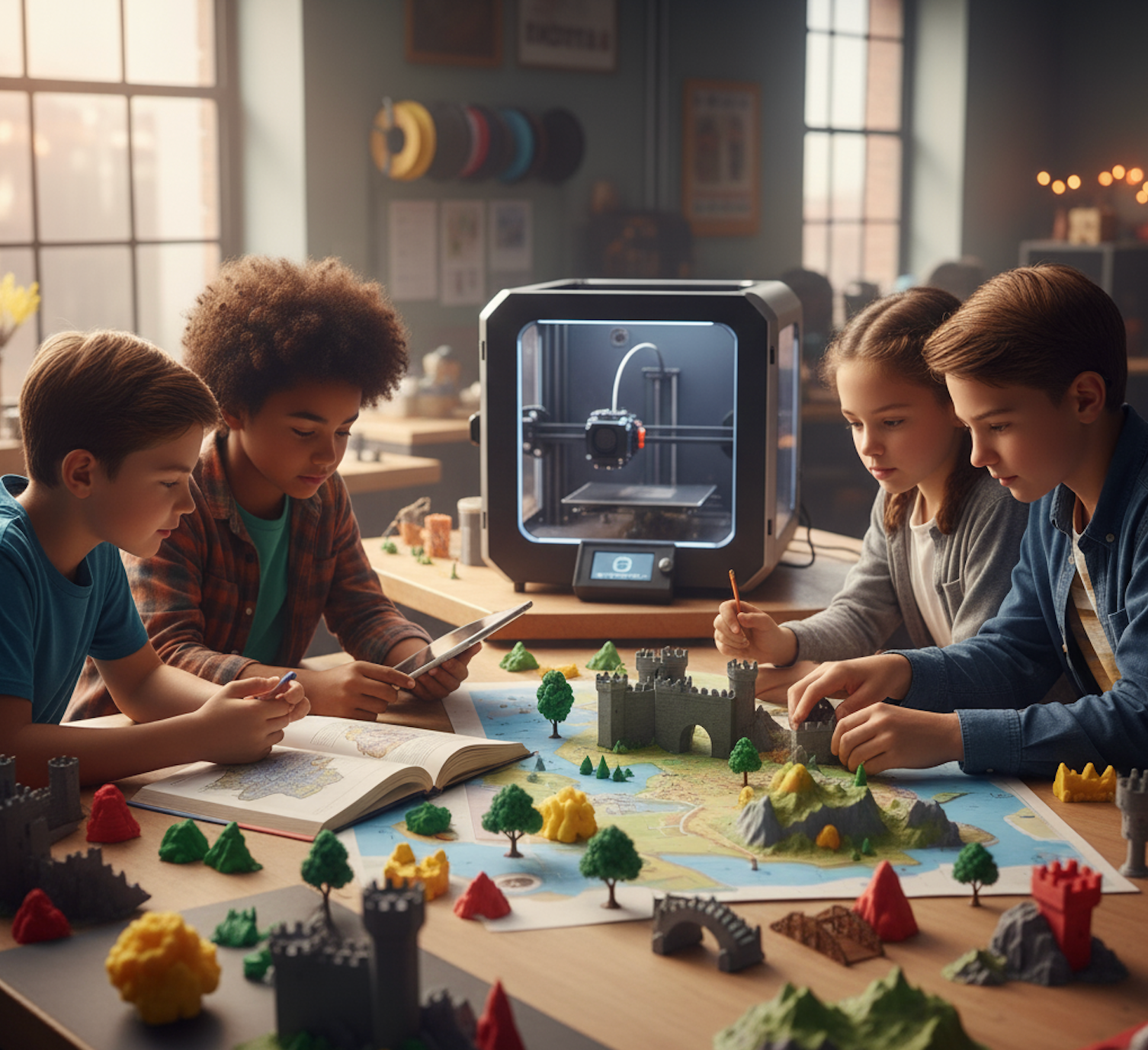
Students can predict what might happen next in a story by creating their predictions in 3D design before the answer is revealed. They can design settings, create story props, or build elements of the world the author describes.
When students read about Narnia or Hogwarts or the dystopian world of The Hunger Games, they form mental images. But those images stay locked in their imagination – invisible to teachers and often vague to the students themselves.
3D printing forces students to make decisions about setting details:
- What does the protagonist’s house actually look like?
- How big is the enchanted forest compared to the village?
- What architectural style fits this historical period?
Suddenly, reading comprehension becomes spatial reasoning. Literary analysis becomes design thinking.
Vocabulary and Language Development
The applications go deeper than literature analysis.
The 3D design environment provides an exciting context for students to practice oral language skills of giving and following directions. Students must use precise vocabulary to describe what they’re creating and instruct peers on how to replicate designs.
For English language learners, 3D printing offers a powerful bridge. A student struggling to express ideas in a new language can design and create – demonstrating understanding without being limited by vocabulary constraints. Then, through the design process, they naturally acquire the language they need: “make it taller,” “rotate the shape,” “add texture to the surface.”
Abstract words become concrete. “Cylindrical” isn’t just a vocabulary word – it’s a shape they’re manipulating. “Proportion” isn’t a concept to memorize – it’s a problem they’re solving in their design.
Differentiated Learning in Language Arts
One of language arts teachers’ biggest challenges: the reading and writing gap in any classroom can span years.
Some students read at grade level and love creative writing. Others struggle with basic comprehension and dread writing assignments. Traditional assessments favor strong writers and penalize everyone else – even students who deeply understand the literature but can’t express it in an essay.
3D printing creates an alternative pathway to demonstrate understanding.
A student who struggles to write a literary analysis essay might create a stunning 3D representation of a novel’s central theme. A reluctant reader might engage deeply with a book when they know they’ll be designing something from it rather than writing about it.
This isn’t “dumbing down” the work. It’s recognizing that understanding can be demonstrated in multiple ways. The student who designs that mockingbird with careful attention to how it represents innocence and loss? They understand the symbolism just as deeply as the student who writes about it.
Maybe even more deeply, because they had to translate abstract meaning into concrete form.
Creative Writing: From Imagination to Reality
Here’s where 3D printing becomes transformative for young writers.
The writing process traditionally moves from imagination to page. Ideas stay trapped in words. But with 3D printing, student writers can bring elements of their stories into the physical world.
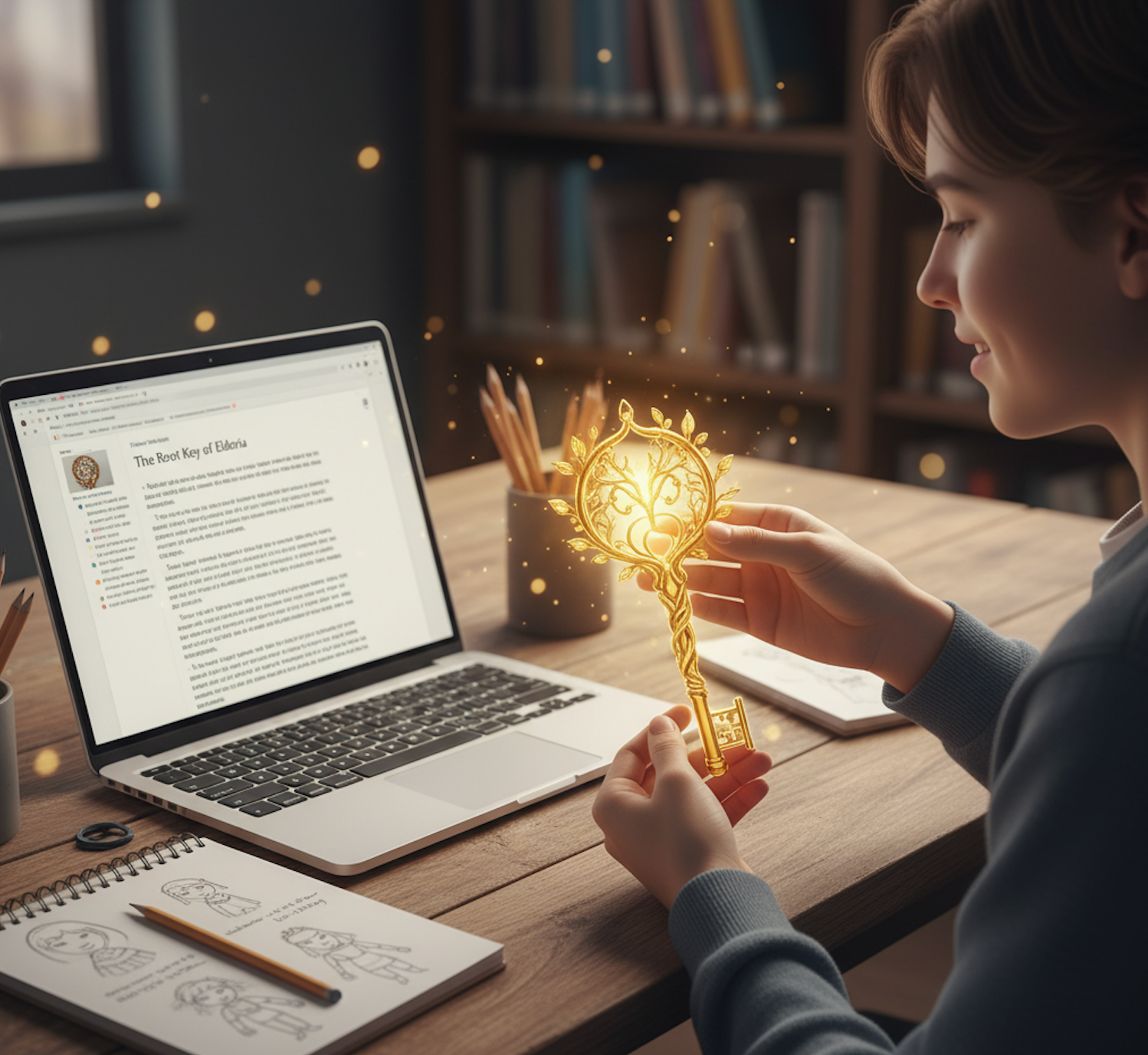
Writing a fantasy story? Design and print a magical artifact your character discovers.
Creating a mystery? Build the crime scene or the crucial piece of evidence.
Developing a science fiction world? Design the technology that shapes your setting.
This doesn’t replace writing – it enhances it. Students who see their story elements as physical objects often write with richer detail. They understand their fictional world more completely because they’ve had to make tangible decisions about it.
And there’s something powerful about holding a piece of your own story in your hands. It makes the creative work real in a way that a Word document never can.
Story Elements Made Physical
Language arts teachers can bring characters from stories to life by printing them as 3D figures. Historical fiction becomes more engaging when students can print artifacts or landmarks from the period.
Each of these projects requires deep reading, critical thinking, and creative problem-solving. They’re not crafts. They’re sophisticated literary analysis disguised as making.
Addressing the Practical Concerns
I know what language arts teachers are thinking: “This sounds great, but I barely have time to cover the required curriculum. How would I add 3D printing?”
You don’t add it. You integrate it.
That unit on symbolism you already teach? Add a 3D design component to the final assessment.
The creative writing project you do every semester? Let students design and print one element from their story.
The novel study with the end-of-unit project? Offer 3D design as one option alongside traditional presentations.
Start small. One project. One novel. See what happens.
What Students Actually Learn
When language arts students use 3D printing, they’re developing skills that go far beyond any single unit:
Critical thinking: Translating abstract literary concepts into physical form requires deep analysis and creative problem-solving.
Spatial reasoning: Understanding how objects exist in three-dimensional space enhances comprehension of setting and physical description in writing.
Design thinking: Moving from concept to creation mirrors the writing process itself – draft, revise, refine.
Precision in communication: Describing designs and giving instructions develops the exact language skills we want writers to master.
Multimodal literacy: Understanding that meaning can be created and communicated through multiple forms – text, image, and physical object.
These are 21st-century literacy skills. And they emerge naturally through 3D printing projects.
The Real Reason It Works
Here’s the truth about why 3D printing is so powerful in language arts:
Reading and writing are acts of imagination. We ask students to see worlds that don’t exist, understand people who aren’t real, and create entirely new realities with words.
3D printing bridges imagination and reality. It takes what exists in the mind and makes it physical.
For students who struggle to engage with abstract literary analysis, this is revolutionary. For students who are already strong readers and writers, it adds a new dimension to their understanding.
And for teachers? It offers a window into student thinking that traditional assessments can never provide. When a student creates a 3D representation of a theme, you can literally see how they understand the text.
Not Just for STEM
So yes, 3D printing helps biology teachers create cell models. Yes, it lets math teachers print geometric shapes.
But it also helps language arts teachers bring literature to life, develop stronger writers, and engage students who’ve been told they’re “not good at English.”
The technology isn’t different. The application is just more creative.
And creativity? That’s what language arts is all about.
👉 Explore more insights at 3dvinci.space/blog
💬 Or share your thoughts below — we’d love to feature your story!
Leave a Reply