

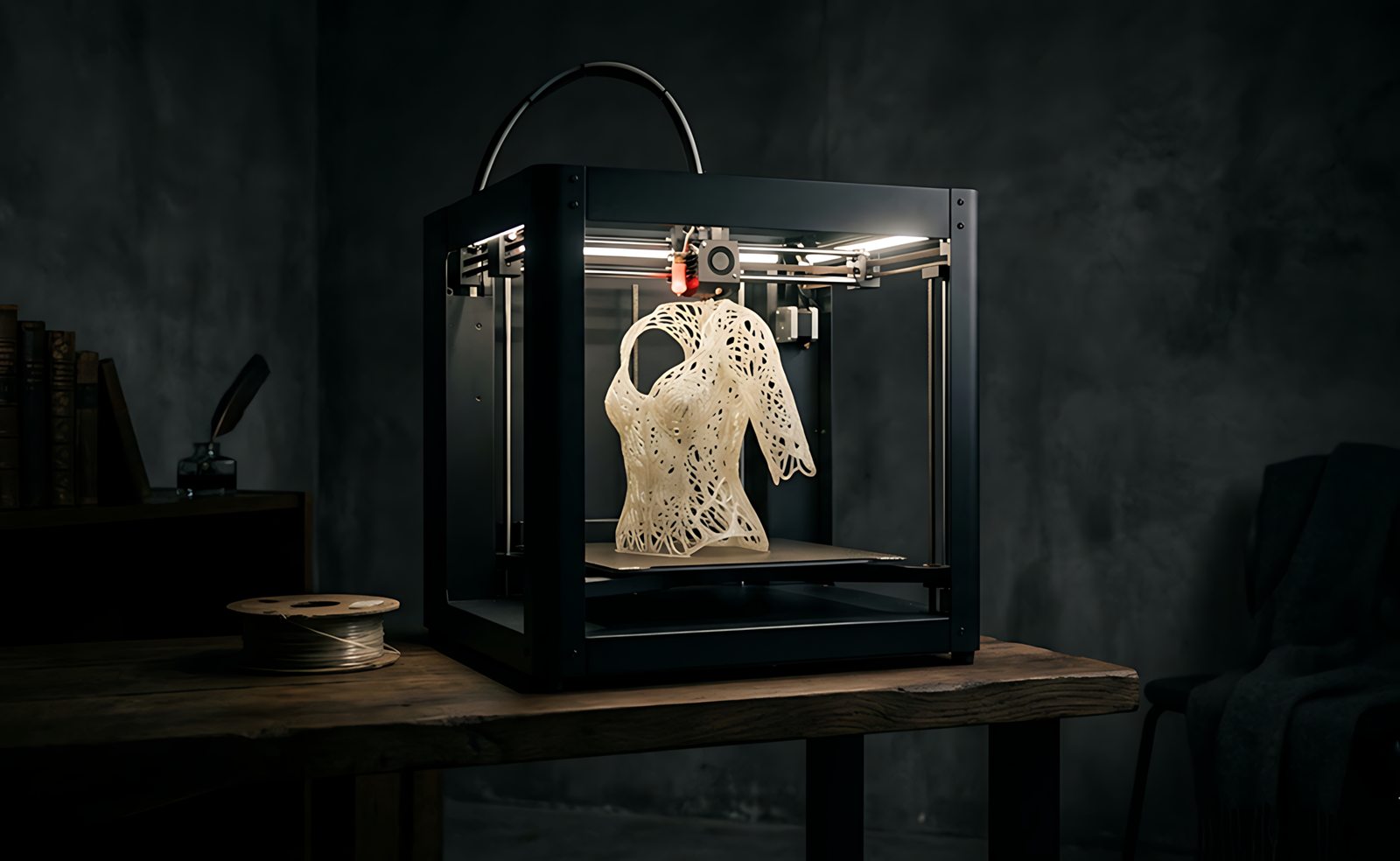
Hi everyone! Welcome to the blog.
We always rave about the good sides of 3D printing here, and I worry we may make it seem like 3D printing fixes everything and it has no flaws. That’s not true at all.
So, I felt it was time for some genuine critique. So here we go.
There was a moment when 3D printing felt like a quiet rebellion. No factories, no overproduction, no piles of unsold clothes suffocating in warehouses. Just an object, summoned into existence exactly when you needed it. Clean, efficient, almost moral.
It promised control. Over production, over waste, over design. It suggested a future where clothing could be made deliberately rather than dumped into existence in anticipation of demand.
It sounded like the antidote to fast fashion.
It’s starting to look like its evolution.
The Problem Was Never Fabric. It Was Speed
Fast fashion is usually framed as a material problem. Cheap textiles, poor labor conditions, disposable garments. All of that is real, and all of it matters.
But none of it explains why the system moves the way it does.
The real engine has always been speed. The ability to compress the time between idea and availability. To take something seen on a runway, or more often on a screen, and translate it into a purchasable object almost instantly.
Collections used to move with seasons. Then they moved monthly. Then weekly. Now, they move continuously. Trends appear, peak, and collapse in weeks, sometimes days. Entire aesthetics rise and disappear before most people even fully register them.
What fast fashion sells is not clothing. It sells access to newness. The feeling of being current, aligned, updated.
And newness depends on friction. Time to design, manufacture, ship, stock, and distribute acts as a natural limit. It slows the cycle down, whether the industry likes it or not.
3D printing doesn’t just reduce that friction. It removes it. It collapses production into a single location. It reduces logistics to a file transfer. It eliminates waiting as a structural feature of fashion.
And once speed is no longer limited, it doesn’t stabilize. It accelerates.
From Garment to File
When clothing becomes digital before it becomes physical, its nature changes.
A dress is no longer just an object. It is a file, a set of instructions that can be stored, shared, altered, and reproduced. It exists as data before it exists as matter.
This shifts the role of the designer. Instead of producing fixed garments, designers create systems. Parametric designs that can adapt to different bodies, preferences, and variations. A single concept can generate hundreds of outcomes.
And once something is a file, it behaves like every other file in a digital ecosystem.
It can be duplicated infinitely at almost no cost. It can be modified in seconds. It can circulate globally without degradation. It can be deleted and replaced without leaving a trace.
This fundamentally alters the idea of ownership. You don’t own a unique object. You access a version of something that can always be recreated.
Permanence becomes optional. Scarcity becomes artificial.
The distance between idea and object collapses.
So does the distance between desire and possession.
Customization Was Supposed to Slow Us Down
Customization is often presented as a corrective to mass production. The logic is simple: if something is made specifically for you, it should carry more meaning. It should fit better, last longer, and reduce the need for excess.
In theory, personalization encourages restraint.
In practice, it encourages iteration.
When everything can be tailored, nothing feels final. You are no longer choosing between options. You are continuously refining them. Adjusting details, proportions, textures, colors. Updating versions of the same item to better align with how you see yourself in the moment.
This changes the nature of consumption. It is no longer about acquiring objects. It is about maintaining alignment between identity and appearance.
The question shifts from “Do I need this?” to “Is this still me?”
And identity is not stable. It responds to mood, environment, social context, and influence. When the cost of updating your external expression drops to almost nothing, the frequency of updates increases.
You don’t necessarily consume less.
You consume more precisely, and more often.
The Sustainability Mirage
3D printing is often framed as a sustainable alternative, and there are valid reasons for that perception.
Material waste is reduced because objects are built additively rather than cut from larger pieces. Production can happen on demand, reducing unsold inventory and minimizing overproduction. Supply chains can be shortened or localized.
On paper, it looks efficient.
But sustainability is not just about how something is made. It is about the entire lifecycle of the object.
Most consumer-grade 3D printing relies on plastic-based filaments. Materials like PLA are often marketed as biodegradable, but their ability to break down depends on controlled industrial conditions that are rarely accessible. In typical environments, they persist far longer than the label suggests.
Energy consumption complicates the picture further. 3D printing is slow and continuous. A single garment can take hours or even days to produce, during which the machine consumes electricity steadily. Different materials require different temperatures, increasing variability in energy use.
Then there is the issue of invisible waste. Failed prints due to calibration errors, material inconsistencies, or design flaws are common. Support structures, necessary for complex shapes, are removed and discarded. Prototypes and iterations accumulate.
These forms of waste are rarely included in simplified sustainability narratives.
Waste did not disappear.
It became less visible, and therefore easier to ignore.
When Production Becomes Instant, Design Becomes Reactive
When production is no longer a constraint, design behavior changes.
Traditionally, the cost and time associated with manufacturing forced designers to commit to ideas. Collections required planning, cohesion, and intention. There was space for development and refinement.
With 3D printing, that pressure decreases. Designs can be produced, tested, modified, and re-released rapidly. The barrier between concept and execution becomes minimal.
This encourages a shift from intentional design to reactive design. Instead of setting direction, designers respond to data. What performs well gets repeated. What doesn’t gets abandoned.
The creative process becomes entangled with metrics.
This does not necessarily eliminate innovation, but it changes its incentives. Novelty is no longer pursued for its own sake, but for its performance within a system that rewards speed and engagement.
Clothing stops functioning as a long-term statement.
It becomes a short-term signal.
The Platformization of Fashion
Once garments become files, they enter platform ecosystems.
They are uploaded, shared, downloaded, rated, modified, and redistributed. They exist within digital marketplaces that prioritize visibility and accessibility.
Platforms introduce their own logic. They reward frequency, consistency, responsiveness, and alignment with trends. The more often something is updated or uploaded, the more visible it becomes.
This mirrors the structure of fast fashion almost perfectly.
Instead of physical overproduction, you get digital over-availability. Instead of excess inventory, you get excess choice. Instead of clearance sales, you get endless scrolling.
The medium changes, but the outcome remains similar.
An overwhelming volume of options, competing for attention.
Excess, redefined.
The System Doesn’t Change. It Adapts
There is a persistent belief that new technologies disrupt existing systems. That innovation inherently leads to transformation.
Sometimes it does.
But often, it is absorbed.
3D printing was positioned as a way to rethink production. To decentralize manufacturing, reduce waste, and empower individuals.
And it still has that potential.
But at scale, it is being shaped by the same forces that shaped fast fashion: efficiency, profitability, and growth.
Efficiency becomes a way to produce more, faster. Customization becomes a marketing advantage. Sustainability becomes a branding strategy.
The underlying logic remains intact.
Produce faster. Sell more. Repeat.
The Real Shift Isn’t Environmental. It’s Psychological
The most significant transformation is not environmental or technical. It is psychological.
When objects can be created instantly, waiting loses meaning. Anticipation, which once contributed to value, disappears. Ownership becomes casual, almost temporary.
If something can be replaced easily, it does not require care. If it can be recreated instantly, it does not require understanding.
This extends beyond objects to identity itself.
If your external expression can be updated as easily as a file, it never has to stabilize. You are not building a consistent aesthetic. You are managing a series of versions.
Identity becomes iterative.
Something you update, rather than something you develop.
The Machine Isn’t the Problem
3D printing still holds radical potential. It can localize production, reduce certain types of waste, enable new forms of design, and provide access to tools that were once restricted.
It can challenge aspects of the current system.
But potential is neutral. It does not determine outcomes.
The direction a technology takes depends on the system it integrates into.
The real question is not what 3D printing can do.
It is what it is being used to do.
Because right now, it is not resisting fast fashion.
It is learning how to keep up with it.
Leave a Reply