

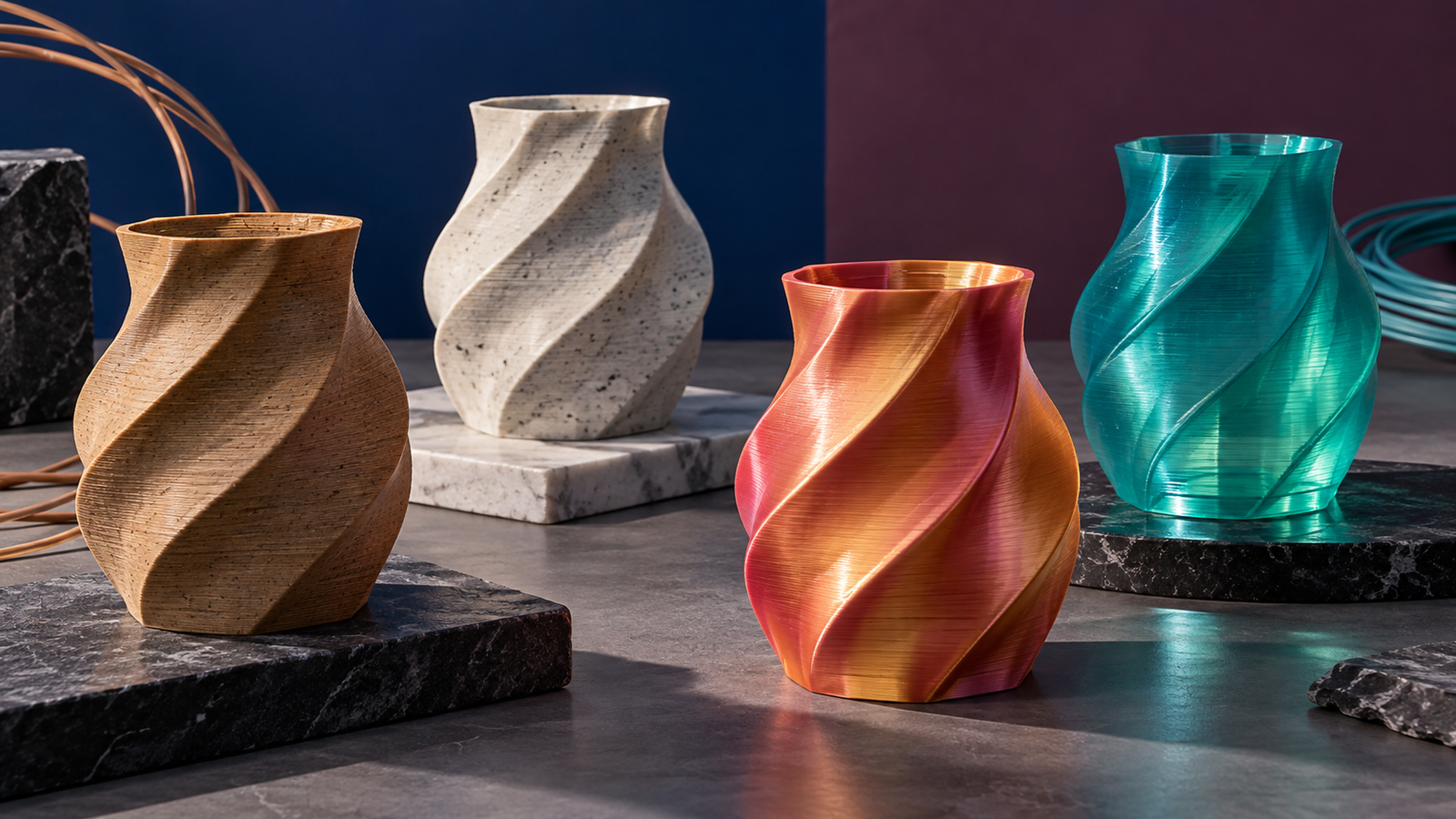
Place two objects printed from the same 3D file next to each other and they may not feel like the same product at all.
One can be quiet, matte and almost stone-like. Another can catch the light with a silky metallic shine. A third may feel warm because tiny wood fibres soften its colour and texture. The geometry has not changed, but the object has.
This is why we do not think of filament as the “ink” of a 3D printer. It is part of the design itself.
Customers often choose the colour—and we enjoy giving them that choice. But the strongest result usually comes from a more complete decision: the right base material, the right surface, the right colour and the right print setup for the exact purpose of the object. When all four agree, a print stops looking like a model that happened to leave a machine. It begins to feel like a finished product.
First ask what the object has to do
The shelves of filament suppliers can be overwhelming: PLA, PETG, ASA, TPU, nylon, polycarbonate, polypropylene, wood, stone, metal, carbon fibre, glass fibre, matte, silk, transparent, glow-in-the-dark—and dozens of variations inside each group.
The useful way to begin is not with the most unusual spool. It is with the job.
Will the object live indoors or outside? Will it sit on a desk, bend in a child’s hand, hold weight, take repeated knocks, stand near heat or spend most of its life being looked at? Does it need crisp lettering, a soft grip, a translucent surface or a very precise brand colour?
Those questions quickly turn a wall of possibilities into a shortlist.
- PLA is often our starting point for detailed indoor objects, prototypes and decorative pieces. It prints cleanly and offers an extraordinary range of colours and effects. Its limits matter too: ordinary PLA is not the first choice for high heat, demanding outdoor exposure or heavily loaded mechanical parts.
- PETG brings more toughness, strong layer bonding and greater heat resistance than standard PLA. It can be excellent for practical parts, although its glossy surface and tendency to form fine strings require a different approach to printing and finishing.
- ASA is designed for more demanding heat, weather and ultraviolet exposure, making it a candidate for outdoor parts. It is also harder to print well and usually benefits from a controlled enclosure and appropriate ventilation.
- TPU and other flexible filaments can turn a rigid model into a bendable grip, protective element, gasket or resilient toy component. Their flexibility is useful precisely because it also makes them slower and more demanding to print.
- Nylons, polycarbonates and polypropylene-based materials extend the possibilities further for engineering uses. They may require careful drying, higher temperatures, specialised build surfaces or an enclosed printer, so they should be chosen for a real performance need rather than for an impressive label.
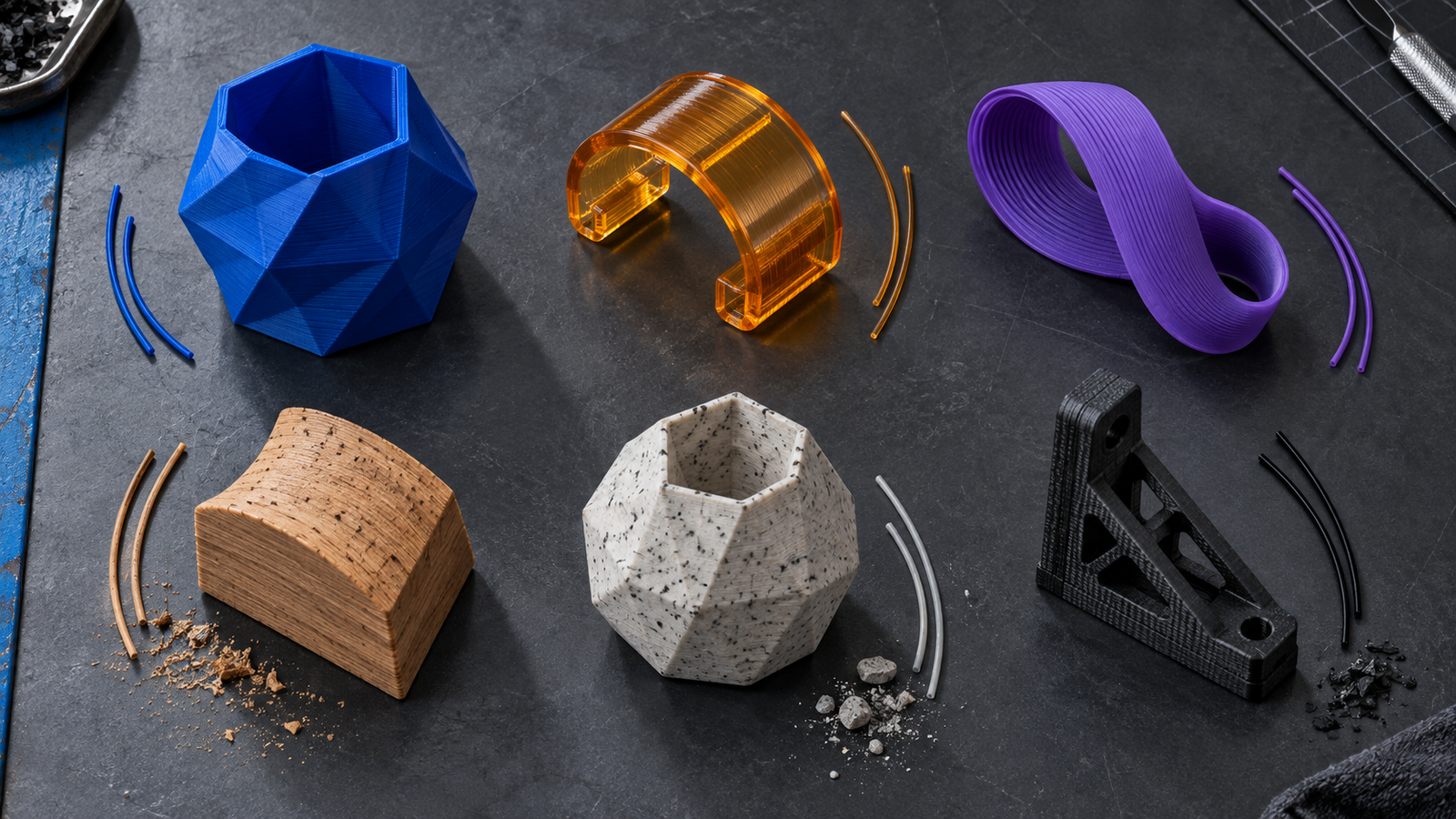
A useful material library is not a collection of fashionable names. It is a set of different behaviours, surfaces and possibilities.
Wood, stone and silk are not all the same kind of material
Names such as “wood,” “stone” and “silk” describe what we see and feel, but they do not necessarily tell us what the base polymer is.
Wood-filled filament is commonly PLA or another polymer mixed with fine wood fibres. It can produce a warmer, more organic surface and, depending on the formulation, may be sanded or stained. It is still a printed composite—not a piece of timber—and the fibres can change flow, strength and nozzle requirements.
Stone- or marble-effect filament may use mineral particles, speckles or carefully designed colour variation to make layers read more like a continuous natural surface. The result can be beautiful for planters, vases, architectural forms and functional décor. But “stone effect” does not mean stone-like structural performance.
Silk PLA does not contain textile silk. The name refers to a glossy, light-catching finish. Curves and layer direction become especially important because they control where highlights appear. The same bright colour in matte PLA can feel soft and contemporary; in a silk formulation it can feel ornamental, energetic or metallic.
Metal-filled filaments take this idea further by adding fine metal powder to a polymer base. Some can be polished for a convincing bronze, copper or steel-like appearance and may feel noticeably heavier. They are not solid metal parts, however, and metal fillers can be abrasive to a standard brass nozzle.
The lesson is simple: the effect name tells us what a material is trying to communicate. The technical data tells us how it will actually behave.
Reinforced does not mean “best for everything”
Carbon- and glass-fibre-filled filaments have become increasingly visible. Their fibres can improve stiffness and dimensional stability, reduce warping in some base polymers and give the surface a refined technical texture. They can be genuinely valuable for suitable functional parts.
They also bring trade-offs. Fibre-filled materials are abrasive and normally need a wear-resistant nozzle. A stiffer print is not automatically tougher in every direction, and some formulations can have weaker bonding between layers. For a colourful desk organiser or a child’s name topper, carbon fibre would add cost and complication without adding meaningful value.
This is one of the most important parts of material selection: a more technical filament is not automatically a better filament. It is better only when its properties answer the object’s real need.
Colour is not the final decoration
We often speak about colour after shape, as if it were a coat added to a finished idea. In practice, colour changes how the shape is understood.
A dark matte colour can make an object feel architectural and quiet. A warm wood tone makes the same geometry feel more domestic. Translucent material reveals depth and layer structure. A glossy silk surface exaggerates every curve. Light colours can expose shadows and fine details; very dark or highly reflective colours may hide them. A playful combination can invite a child to touch an object, while a carefully muted palette can make it belong naturally in an adult workspace.
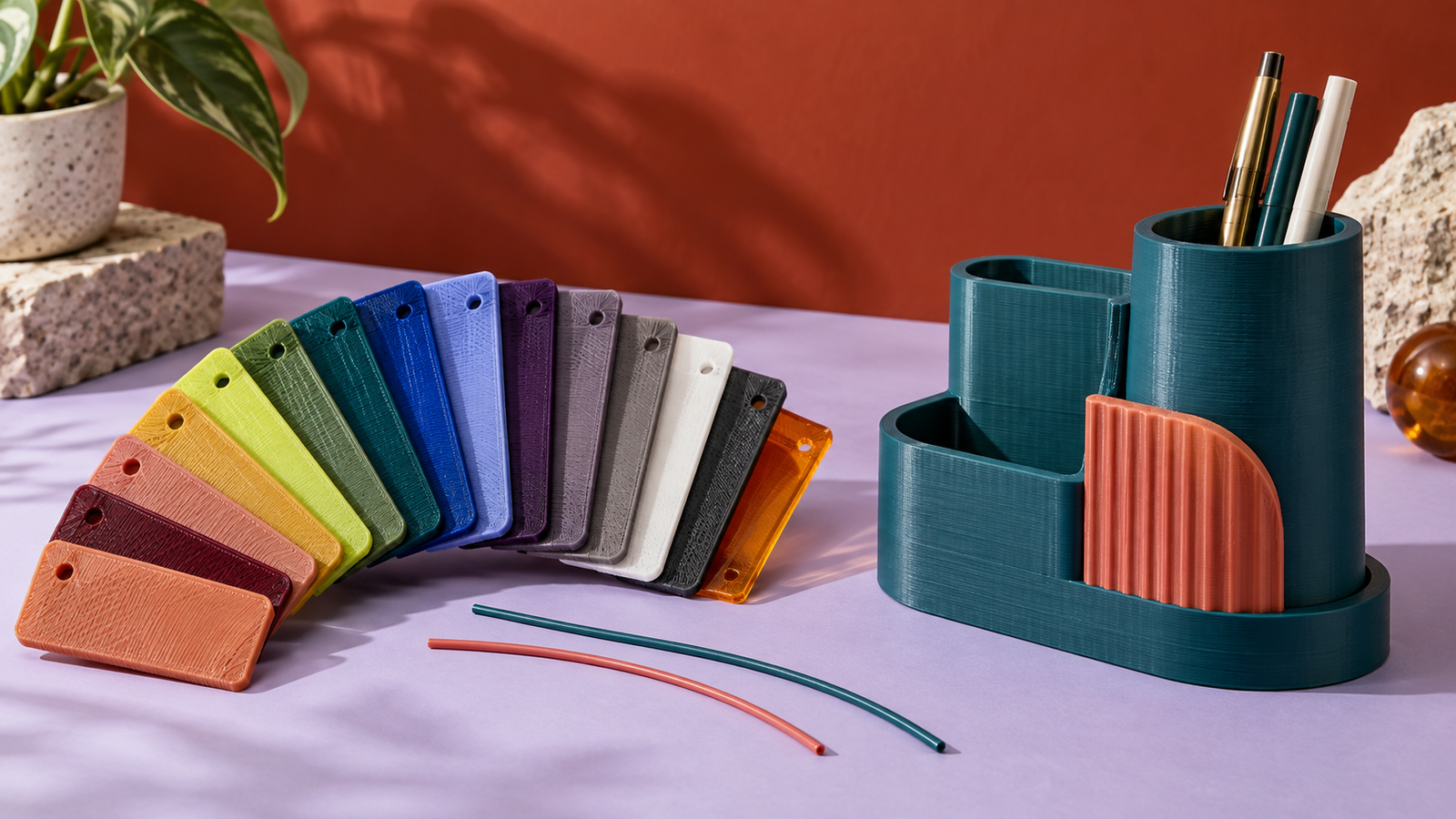
Colour works together with material, light and geometry. Selecting it well is part of product development, not just personal taste.
Customers should be able to express what they like, but a useful colour conversation goes beyond “blue or red?” We look at where the object will live, which colours surround it, who will use it and what the product should communicate. Sometimes the most original choice is not a loud colour, but the exact unusual shade that makes a familiar object feel newly considered.
Screens make this harder. The same digital colour can look different on two phones, and a filament changes again under warm home light, cool office light or direct sun. Gloss, opacity, layer direction and even the neighbouring colours influence what the eye sees. When a precise match matters, a physical filament sample or a recognised colour reference is much more reliable than a product photograph alone.
The industry is responding to this need. Some manufacturers now offer extensive RAL-based palettes and small-quantity custom colour matching. Others measure and monitor colour during filament production. New slicing tools are even beginning to model how two filaments can be layered or interleaved to create additional perceived colours. These methods are promising, but they still depend on the exact materials, printer and viewing conditions.
A beautiful spool can still be the wrong choice
Material selection is also process selection.
Some filaments absorb moisture from the air. If they are not stored and dried correctly, the print may develop rough surfaces, bubbles, weak sections or excessive strings. Filled materials can clog small nozzles. Abrasive additives can wear them. Flexible filament may need a slower, more controlled feed path. ASA and advanced engineering polymers ask for more heat and environmental control than an open desktop printer can provide.
Even changing colour halfway through a print is easier when both filaments belong to compatible material families. Two attractive materials can still bond poorly to one another.
So before choosing a filament, we ask:
- What function must this object perform?
- Will it face heat, sunlight, moisture, impact or repeated bending?
- How should it feel in the hand and look in its final space?
- Does the finish need to be matte, glossy, textured, translucent or easy to post-process?
- Can the printer, nozzle and storage process handle the material consistently?
- Is the extra cost or complexity visible in the value of the final product?
These questions protect us from choosing a dramatic material that photographs well but performs badly—or an unnecessarily industrial one for a simple everyday object.
What is changing now
The most interesting development in filament is not one universal “material of the future.” It is specialisation.
Lightweight foaming PLA can expand as it prints, reducing part weight and using less material for a given volume. It is finding uses in model aircraft, cosplay and other large, weight-sensitive forms. Recycled PLA and PETG are becoming more available, sometimes with the colour variation of the recovered feedstock left visible rather than hidden. PHA and other biobased formulations are entering commercial catalogues, although environmental and end-of-life claims must always be checked for the exact product and the conditions in which it will actually be handled.
At the technical end, manufacturers are developing more fibre-reinforced polymers, flame-retardant grades, electrostatic-dissipative materials, highly luminous pigments and dense or magnetically responsive composites. Water-soluble and breakaway supports make geometries possible that would otherwise be difficult to print cleanly. Smart spool tags can now carry material and colour information directly to compatible systems.
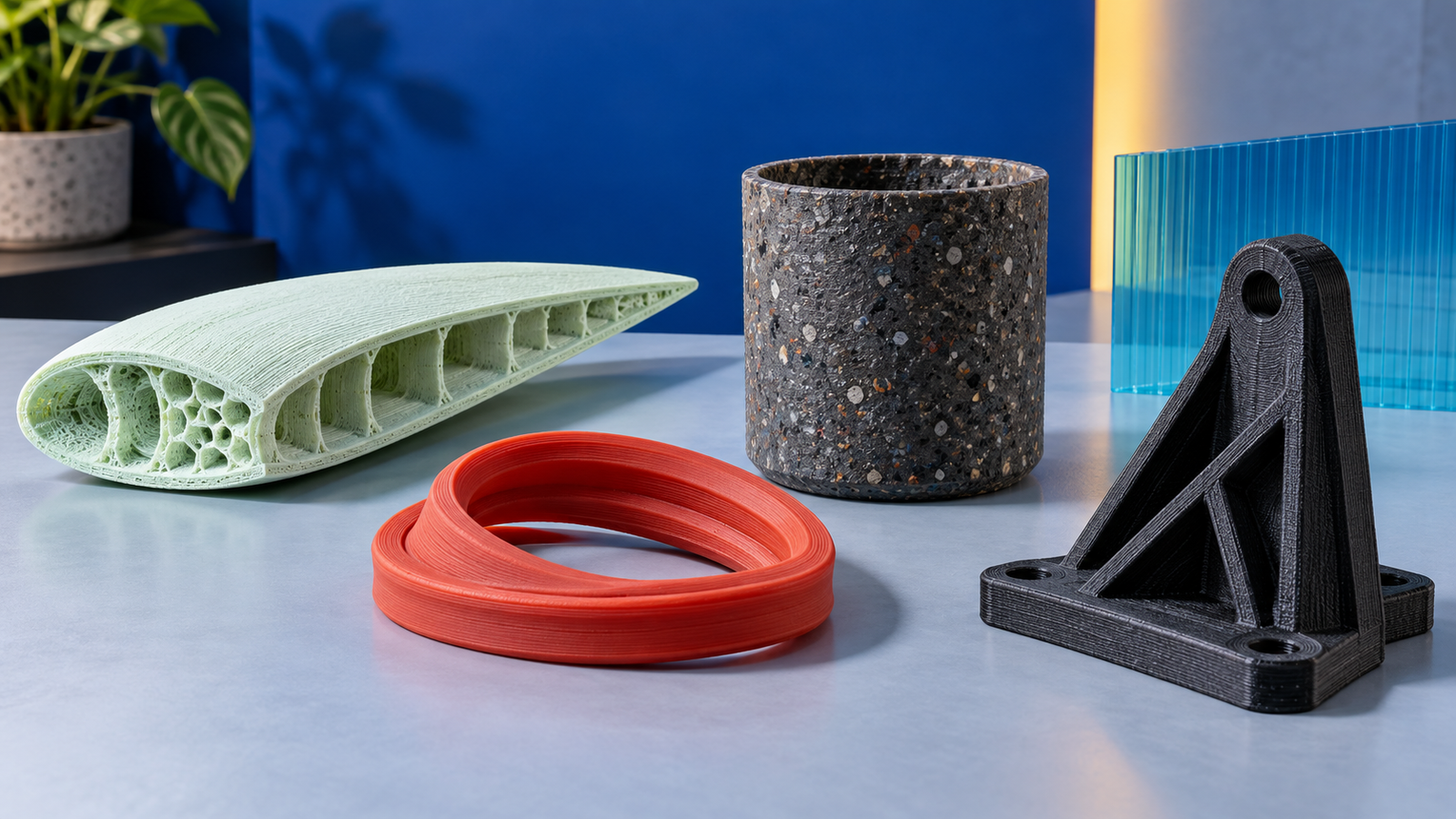
The direction is greater specialisation: lighter, more flexible, more traceable, more precisely coloured and more purpose-specific materials.
All of this is exciting, but it makes judgement more valuable, not less. A specialised filament still needs the right object, hardware, settings and expectations.
The exact material for the exact purpose
At 3D Vinci, we love that customers can take part in choosing colours. Personalisation is one of the reasons 3D printing feels close and human. But our responsibility is also to guide the choice when material, finish or colour will change the performance and character of the product.
Sometimes standard PLA in the right colour is the most honest answer. Sometimes a wood-filled material gives functional décor the warmth it was missing. Sometimes translucent PETG makes light part of the object. Sometimes the unusual shade—a deep petrol blue, a quiet mineral green, a warm clay tone—is the detail that turns a useful print into a memorable product.
The best result rarely comes from selecting the most exotic spool. It comes from making several careful choices agree.
The model gives the object its form. The filament gives it behaviour. The finish gives it a voice. And colour decides how we meet it for the first time.
That is why material is never the final detail. It is part of the design from the beginning.
Leave a Reply